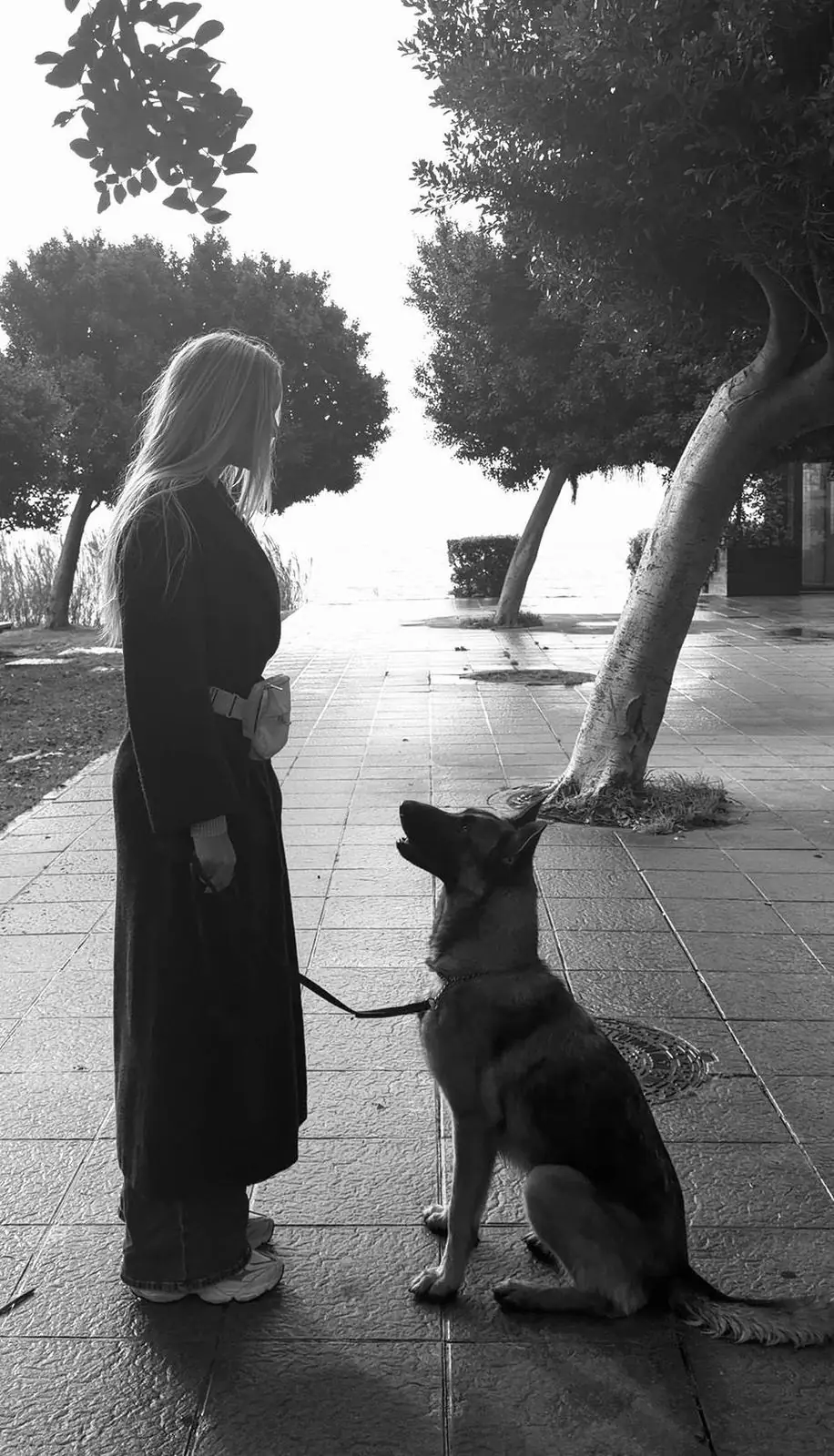

Dogs pull because excitement is high, pulling gets them there faster, and pressure on the lead invites a counter-pull. That is why corrections rarely fix it. A loose lead is built in two places that are easy to overlook: the front door, and a quiet place where your dog can still think.
Walk any paseo on the Costa del Sol in the evening and you will see it: dogs towing their people like small, determined tugboats, and people hauling back. Plenty of those owners have tried the jerk back, the stern voice and the expensive harness. The walk is still an argument.
It stays an argument because a lot of advice treats pulling as a manners problem. It is a state problem, and once you treat the state, the manners get cheap.

Why does my dog pull on the lead?
Three reasons: arousal, reinforcement and reflex. Leaving the house is exciting, and high arousal wants a speed your legs cannot match. And pulling works: every metre gained on a tight lead teaches your dog that tension is the price of progress.
Then there is the opposition reflex. Steady pressure tends to be met with counter-pressure, so when you haul back, the dog leans harder into the collar. Notice what is missing from the list: dominance, stubbornness, disrespect. A pulling dog is not staging a coup.
Is pulling a sign of disobedience?
No, and your own kitchen shows it. The dog that drags you down the street can probably walk beside you from the sofa to the fridge. The skill is there. What changes outside is the state: excitement past the point where your dog can think.
We call that point the red line, and our note on where your dog’s red line sits maps it in detail. Under the line, a dog can learn a loose lead. Over it, a dog is in no state to learn much at all.
| What happens | The obedience reading | The arousal reading |
|---|---|---|
| The dog charges ahead | It is trying to lead | Its excitement is running ahead of its legs |
| Ignores the heel cue | It is being defiant | The cue cannot reach a flooded brain |
| Explodes out of the door | Bad manners | The walk’s most excited moment, unmanaged |
| Pulls harder after a correction | It needs a firmer hand | Opposition reflex plus added adrenaline |
Why do lead corrections make it worse?
Because a jerk on the lead adds arousal to a dog that is pulling because of arousal. The correction stings, adrenaline rises, the reflex braces harder, and moments later the lead is tight again. Keep it up for months and the habit is still there.
Treat the state, and the manners get cheap.
New equipment does not fix pulling either. Hardware moves the pressure around without removing its cause, so choose it for safety and control. For a dog that still pulls, a well-fitted harness keeps the pressure off the throat while you train, and we compare the options in slip lead, harness or flat collar.
Where does a loose lead start?

At the front door, before the walk has begun. If clipping the lead sets off spinning and whining, and the door opens onto that, the walk starts at its most excited point and the rest of it is spent recovering.
Change the first two minutes and the whole walk starts from a calmer place. None of it needs more than patience at the door and a slower start outside:
- Lead goes on calm. Pick up the lead, and if the party starts, put it down and wait. Clip it when all four paws are on the floor. It is dull, and it is the part that matters.
- The door opens on a calm dog. Door opens, dog waits a beat, you step out together. Bolting through doorways is practice for bolting everywhere.
- The first stretch is slow. Let the nose come down and the brain arrive. A slow, sniffy start tends to take more of the edge off than a brisk march does.
How do I teach a loose lead?
Pay the position, make tension pointless, and train where your dog can win. The working loop is short:
- Every time your dog is beside you on a soft lead, pay it: food, a change of pace, or permission to go and sniff.
- When the lead goes tight, stop. Move again the moment it goes slack.
- Turn and walk the other way now and then, and pay your dog when it catches up.
- Start on a quiet street and build up to the Saturday market. Ten good minutes beat an hour of hauling.
Private training can take this same work onto a real route: you hold your own lead, and we walk beside you and coach your handling while you learn to read your dog’s arousal yourself. Foundation, Volume 01 of Locus CODE™, starts one step earlier, with the dynamic between you and your dog.
What if the pulling is aimed at other dogs?
Then this is reactivity work, and the plan changes. A dog pulling towards other dogs out of frustration or worry needs distance and threshold work before position training means anything. Start with why dogs lunge at other dogs; the skills in this note become trainable once you can keep your dog under its red line around other dogs.
If there has ever been a bite, or a near miss, do not work this out alone: read reactivity or aggression, how to tell and see where to start before any lead training.