
It depends on the dog and on what the walk is for. For clear guidance on everyday and training walks, we like a slip lead, fitted high behind the ears with the stopper set, on a dog that is not pulling into it. A harness is the safety choice, and the tool for sports where pulling is the point. A flat collar suits a sensitive dog and carries the ID tag. None of them trains the dog.
Owners often look to equipment for a shortcut, and it is easy to see why. A new lead or harness is cheap and arrives tomorrow, while training takes weeks of attention. When they ask us, the question usually names a product: is a slip lead right, should we get the harness, is the collar enough?

Start with what the lead is for. It is not a steering wheel. It is a telephone line between two nervous systems. Tension in your hand travels down it to the dog, and the dog’s excitement or worry travels back to you. Every tool changes what that line carries. Dogs tend to lean into steady pressure, so a lead held tight usually brings more pulling.
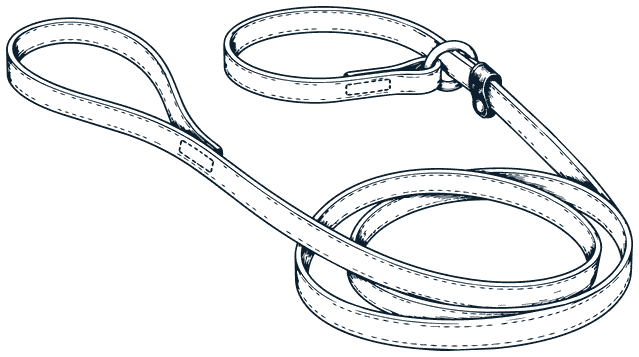
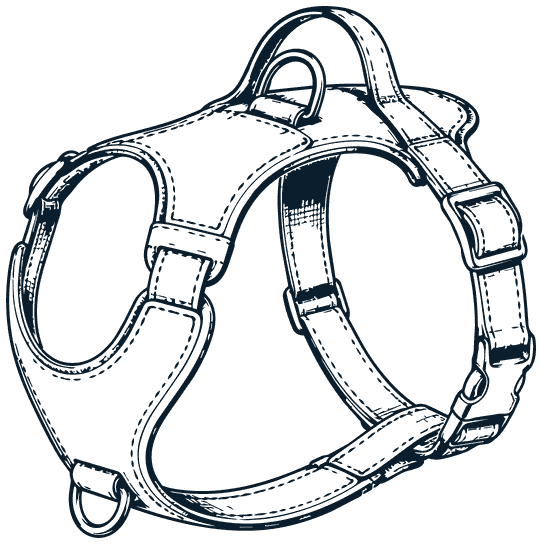
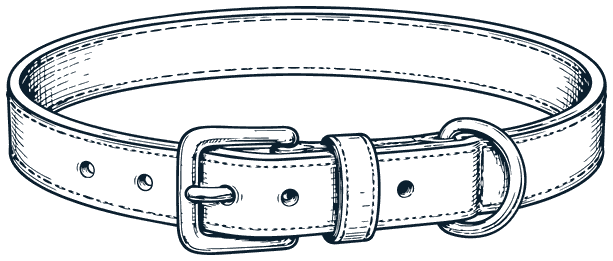


How do the three compare?
By where the pressure lands, and how clearly your dog reads it. A slip lead fitted high sits on the muscle behind the ears, where a light touch says a lot. A flat collar sits low, over the windpipe. A harness spreads pressure across the chest and body, which makes it safe and blunt.
| Slip lead | Harness | Flat collar | |
|---|---|---|---|
| What it is | A loop that tightens and releases, held high by a stopper | Spreads pressure across the chest and body | A fixed band that does not tighten |
| Communication | Clear: a light touch high on the neck says a lot | Blunter; signals spread over a broad, strong area | Enough for a sensitive dog; unclear on one that leans |
| If the dog pulls | The loop drops to the throat: not for a dog that leans all walk | Comfortable and safe, which suits running and cycling | Throat pressure on every pull, coughing, strain over time |
| If the dog lunges | Loads the neck: work at a distance where he stays calm | Safest option: the throat is protected | The full hit lands on the throat |
| Escape risk | Very low once correctly fitted | Low with a good fit; poor fits back out | Real for narrow-headed and frightened dogs |
| Demands on the handler | A fit to learn once, then a soft hand | Low: forgiving of mistakes | Low |
When is a slip lead the right tool?
On everyday and training walks, once it is fitted properly. Set high on the neck, just behind the ears, with the stopper holding it in place, a slip lead passes on a very light touch. Your dog reads it easily, so you need to say less, and the throat stays clear.
The conditions matter. The stopper keeps the loop from sliding down, and the dog should never spend the walk leaning into it. Once the loop drops to the throat, it tightens on the windpipe and the reason to use one is gone. If you have not used one before, ask a trainer to show you the fit.
If your dog hits the end of the lead when other dogs appear, start with why dogs lunge at other dogs. That problem is solved with distance and threshold work, whatever the dog wears. If there has been a bite, or you are unsure, book a private session before you change anything else.
When is a harness the right tool?
For safety, and for sports where the dog is meant to pull. A harness takes the pressure off the neck altogether. On a new dog, a rescue or one that has slipped out before, attach the lead to a collar and a harness together, so if one fails the other holds.
Running and cycling with your dog are where a harness is at its best, because leaning into it is the whole point. On the back clip, it also pairs well with a long line in quiet places.
The trade is guidance. Pressure spread over a broad, strong part of the body tells the dog much less, so a harness is the blunter tool when you want to guide precisely in training. Fit matters too. A strap that runs straight across the front of the shoulders restricts movement, and a loose harness is easy to back out of.
A harness also makes pulling comfortable, so pair it with a training plan. That plan is in loose lead walking: pulling is arousal.
Is a flat collar enough?
For ID, always. For walking, it suits a sensitive dog best. A flat collar is a simple band that does not tighten. It carries the tag with your phone number, and on a dog who notices the smallest signal, a light touch through it can be all the guidance you need.
It sits low, over the windpipe, where a pull does the most harm and gets the least across. On a dog who leans into it all walk, or barely notices it, you end up repeating pressure in that one spot.
If your dog coughs on walks, move the lead to a harness today, and ask your vet to check the throat if the cough carries on. Then work on the walking itself.
What matters more than the tool?
The state of your dog and the state of your hands. We treat pulling and lunging as threshold problems. Past a certain point of excitement or worry, a dog cannot take in what you ask, and no piece of kit moves that point.
What moves it is ordinary training: walks planned at a distance your dog can cope with, the position you want rewarded often, time to recover after a hard moment, and a lead hand that stays soft because you are calm.
What should I buy?
A short kit, fitted to the dog in front of you. Nothing on it does the training for you. For a dog that reacts on walks, Volume 02, Reactivity, has a chapter on equipment.
If you would rather have someone check the fit and your handling on a real walk, book a private session out on your usual route.
- A flat collar with an ID tag, worn always
- A slip lead with a stopper, once you have been shown the fit
- A harness for safety, clipped alongside the collar on a new dog
- A two-metre lead, plus a long line for quiet places
- A slip lead left to slide down onto the throat
- Anything that works through pain or startle
- A tighter tool as the answer to a threshold problem
- Any tool without a training plan alongside it